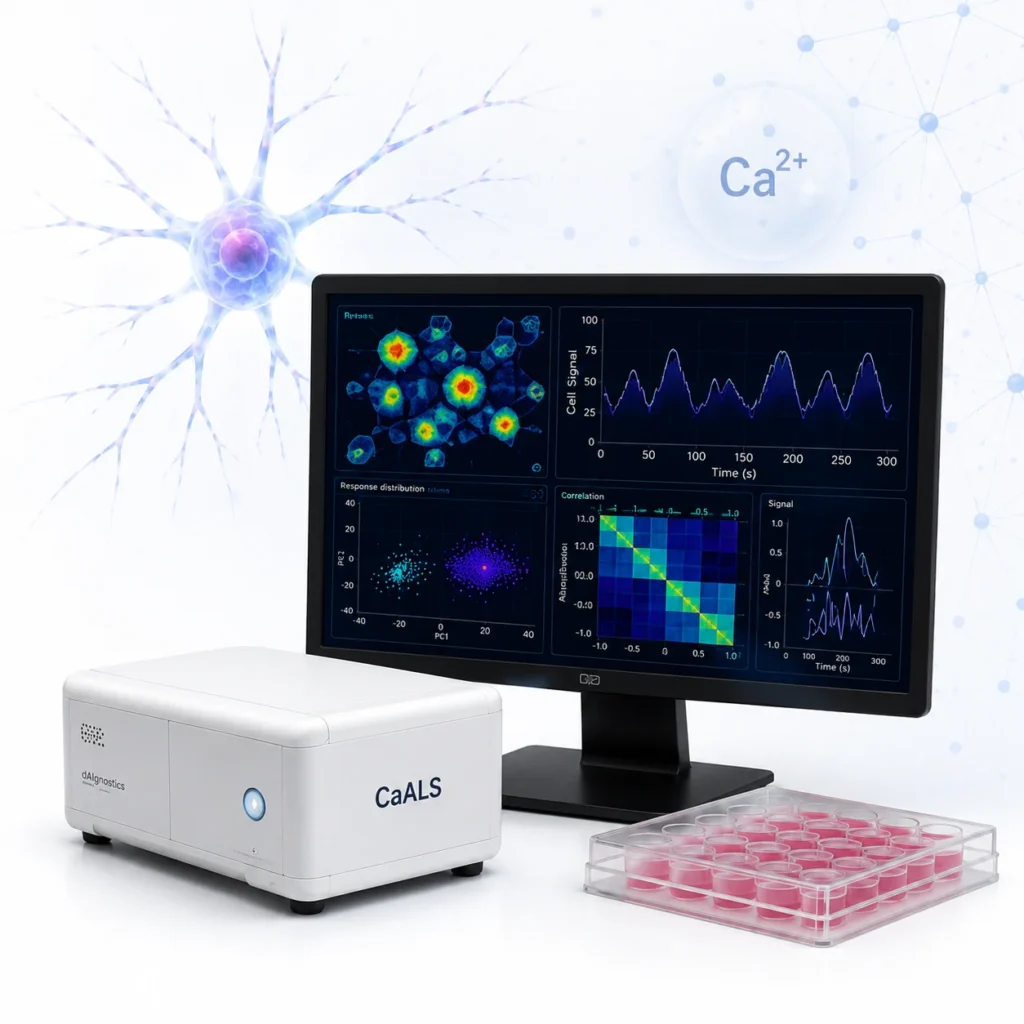
CaALS: AI-Powered Calcium Signal Analysis for Early ALS Diagnostics

Turning living-cell responses into diagnostic insight

CaALS develops the analytical layer of the dAIgnostics ALS diagnostic method, transforming time-resolved calcium-response signals into structured, AI-ready diagnostic data. The project builds on the dAIgnostics method, where patient-derived IgG triggers measurable physiological responses in healthy cells of neural origin. CaALS focuses specifically on intracellular calcium signaling, applying signal processing, numerical analysis and machine learning to identify disease-relevant patterns.

Funded by the European Union – NextGenerationEU. The views and opinions expressed are solely those of the author and do not necessarily reflect the official views of the European Union or the European Commission. Neither the European Union nor the European Commission can be held responsible for them.


Challenge

ALS remains difficult to diagnose early. Current diagnostic pathways are often lengthy, complex and based on the exclusion of other conditions. This delay can limit timely intervention, patient stratification and participation in clinical studies. For earlier ALS diagnostic support, complex biological signals need to be captured, processed and interpreted in a more objective and scalable way.

Solution

CaALS supports an AI-powered workflow for analyzing calcium-response recordings: Patient-derived IgG → Living-cell response → Calcium signal recording → Feature extraction → AI analysis → Diagnostic-support report.

The project converts temporal calcium signals into structured data that can be processed through advanced signal analysis and machine-learning models. This enables more consistent interpretation of functional cellular responses linked to ALS-related mechanisms.

What CaALS develops

Signal analysis tools

Methods for processing time-resolved calcium-response recordings and extracting relevant signal features.

Machine-learning models

AI-based models designed to identify disease-related patterns in complex cellular response data.

Cloud architecture

A scalable digital environment for secure data processing, analysis and workflow integration.

Graphical user interface

A user-facing interface for managing recordings, analysis outputs and diagnostic-support workflows.

AI-supported reporting

Report generation tools that translate analytical results into clear, structured outputs for expert interpretation.

Role within the dAIgnostics platform

CaALS supports the dAIgnostics Method and dAIgnostics Studio layers by extracting meaning from calcium-response signals through numerical analysis, machine learning and AI-supported reporting.

Patient-derived IgG

Living-cell response

Calcium signal recording

Feature extraction

Diagnostic-support report

Project funding information

The project “Computer diagnostics of ALS using temporal recording of the signal of physiological intracellular calcium response to immunoglobulins – CaALS” is funded by the European Union – NextGenerationEU under the National Recovery and Resilience Plan 2021–2026, Call “Strengthening Acceleration Activities”, call code NPOO.C1.1.2.R2-I4.01.

  • Project beneficiary: DAIGNOSTICS d.o.o.
  • Project code: NPOO.C1.1.2.R2-I4.01.0106
  • Project acronym: CaALS
  • Project duration: 12 months from 10th of December 2024 Until 10th of June 2026.

Project description

The CaALS project focuses on the development of an innovative method for early diagnosis of amyotrophic lateral sclerosis using temporal recording of the signal of physiological intracellular calcium response to patients’ immunoglobulins.

Expected project result

The expected result of the project is the advancement of computer diagnostics of ALS through the development and validation of an analytical approach that connects cellular physiological responses, numerical signal processing and AI-based data interpretation.

Scroll to Top